The ₹20,000 Fan: What My Sister’s Delhi Smog Purchase Taught Me About Engineering
- ayush singh
- Jan 13
- 3 min read

Every year, around November, my phone starts buzzing with the same frantic energy. My friends and family in Delhi are in “Air-pocalypse” mode. You know the feeling—the air smells like burnt crackers and sulfur, and the sun is just a faint orange smudge in the grey sky.
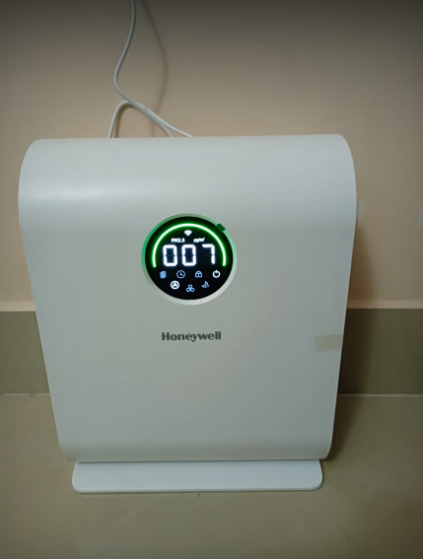
Last month, my sister called me. She was worried about the pollution and had just hit "Buy Now" on a sleek, ₹20,000 Honeywell air purifier she saw on Filpkart. It had a "Smart AI" sensor, five different colored lights, and a mobile app that graphed her indoor air quality in real-time.
She felt relieved. She thought she’d bought the best protection money could buy.
As a Mechanical Engineer, I couldn’t help myself. When I visited, I didn’t look at the app or the pretty lights. I opened the back panel. What I saw inside was… well, it was a fan. A small, plastic fan and a folded piece of HEPA paper.
"You didn't buy a health device," I told her. "You bought a very expensive fan with a really good marketing team."
The "Aha!" Moment: Finding Smart Air
That experience led me to the work of Thomas Talhelm, the founder of Smart Air (A Company That Tells You Not to Buy Its Products). Thomas’s story is the ultimate "First Principles" engineering tale.
The most fascinating thing about Thomas? He’s not a traditional mechanical engineer. He was a Psychology major (with a PhD from the University of Virginia). While living in Beijing during the 2013 "Air-pocalypse," he noticed a strange psychological phenomenon: people believed that if a machine didn't cost $2,000, it couldn't possibly save their lives.
Thomas decided to test the physics, not the marketing. He took a simple 12-inch floor fan, strapped a HEPA filter to it with a Velcro strap, and used a laser particle counter to see what happened.
The result? It removed 92% of PM2.5 particles. Thomas founded Smart Air as a social enterprise to challenge the "Big Air" companies that were profit-gouging scared parents. But here is the "awesome" part: He doesn’t just sell filters; he teaches you how to make your own.
If you go to the Smart Air website, one of the first things you’ll see isn't a "Buy Now" button for their most expensive unit. Instead, you'll find a DIY video showing you exactly how to strap a filter to a fan.
As a business model, it’s counter-intuitive. As a mission to save lives, it’s revolutionary. Thomas openly challenges the market prices of giants like Dyson and BlueAir, publishing open-source data that proves their "patented technology" often performs no better than his basic fan-and-filter setup. He’s essentially using his psychology background to break the spell that "expensive" equals "effective."
Why This Matters to Me as an Engineer
In my work, I spend a lot of time looking at LEED compliance and energy efficiency. We often think that "Sustainability" has to be expensive or "High-Tech." But Smart Air proves that technical soundness is about effectiveness, not price.
Thomas Talhelm is an amazing person because he didn't take the venture capital money that would have forced him to raise prices. Instead, he started a social enterprise. He open-sourced all his data, showing the world that you don't need a ₹25,000 machine with "AI sensors" to protect your lungs. You just need a fan that can move enough air through a HEPA-13 media.
The Takeaway
When my sister’s "Smart" purifier eventually needed a replacement filter, the proprietary filter alone cost almost ₹4,000. That’s the "subscription trap" of modern engineering.
Smart Air reminds us that as engineers, our job isn't to build the most expensive solution—it’s to build the most accessible one. Whether it’s designing a net-zero house like Project Vivaan or simply strapping a filter to a fan, the best engineering is the kind that actually serves people.
Next time you’re about to click "Buy" on a fancy gadget, ask yourself: Am I paying for the physics, or am I paying for the plastic?


Comments